

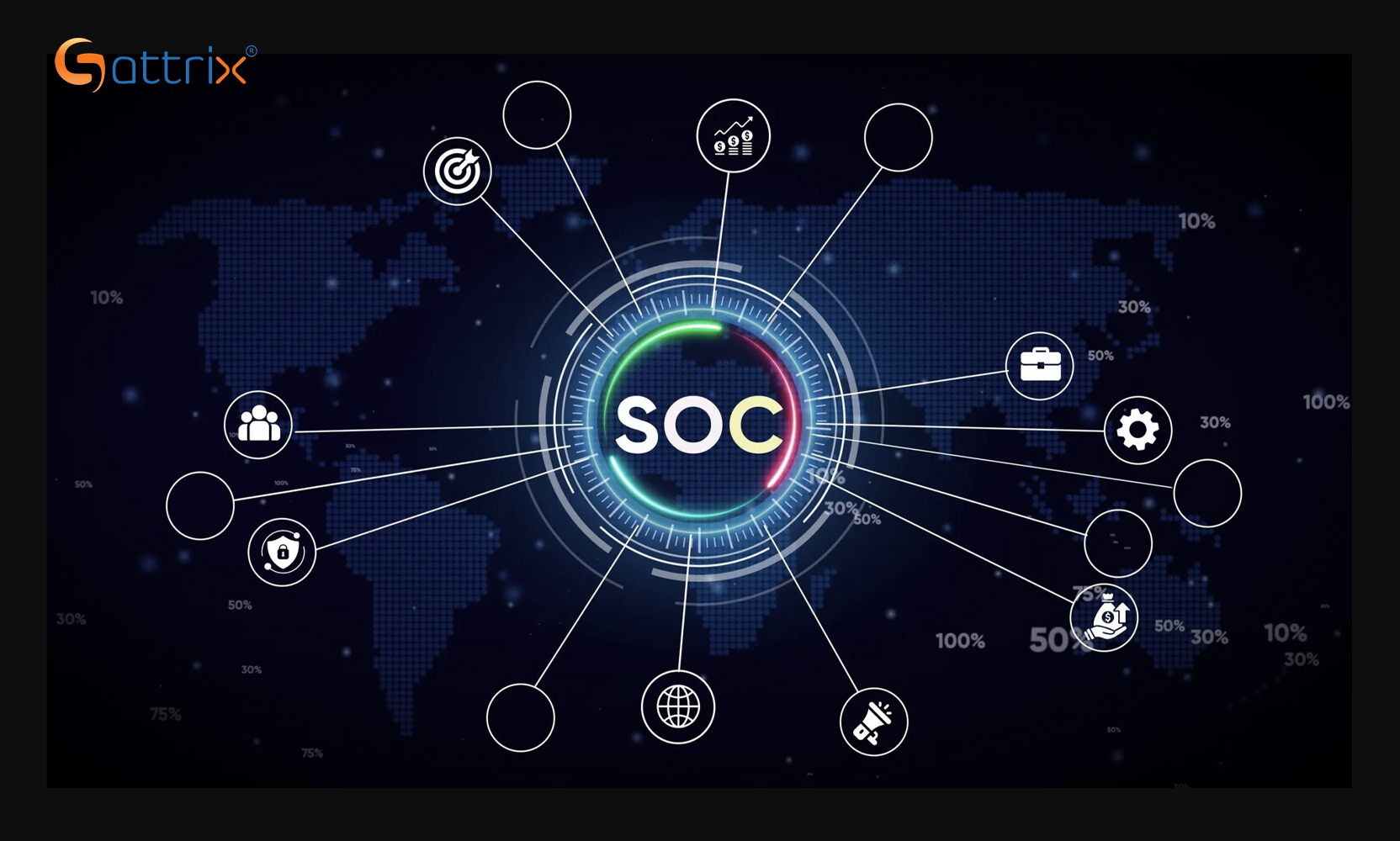
Security operations did not become complex overnight. It evolved quietly.
As organizations expanded into cloud, adopted SaaS platforms, enabled remote work, and layered multiple security tools for visibility, something unintended happened. Security became fragmented. Signals increased, but clarity did not.
At the same time, threat actors adapted faster than most defense strategies. Attacks became multi-stage, identity-driven, and designed to evade isolated detection systems.
This is where the Security Operations Center, or SOC, becomes critical.
Not as a monitoring function, but as a continuous decision-making system.
A Security Operations Center (SOC) is often described as a centralized unit that monitors and responds to threats. That definition is technically correct, but strategically incomplete.
A modern SOC is where:
It is the operational layer that connects security tools, human expertise, and real-time response into a single, functioning system.
Without it, security remains reactive. With it, security becomes operational.
A SOC is not a tool or a dashboard. It is a continuous loop.
It begins with log management and telemetry collection, pulling data from endpoints, networks, cloud environments, identity systems, and applications. This data is then processed, typically through a SIEM platform, where events are normalized and correlated.
From there, detection mechanisms identify anomalies or known threat patterns. But detection alone is not enough.
This is where human analysts step in.
They investigate alerts, validate whether they represent real threats, and initiate response actions when required. These actions may involve isolating endpoints, disabling accounts, or escalating incidents.
Over time, this entire process improves itself. Detection rules are tuned, false positives are reduced, and response workflows become more efficient.
This continuous cycle is what enables 24/7 SOC monitoring services to function effectively, not just continuously, but intelligently.
A SOC operates at the intersection of three layers.
SOC analysts operate across tiers, from initial triage to deep investigation and proactive threat hunting. Their role is not just to respond, but to interpret.
This includes:
Modern SOC architecture is no longer siloed. It is:
A SOC is only as strong as the alignment between these layers.
On paper, building a SOC is straightforward.
Define requirements. Deploy tools. Hire analysts. Establish processes.
In reality, it is one of the most resource-intensive initiatives in cybersecurity.
Organizations must invest in:
Even after all of this, challenges persist. Coverage gaps, alert overload, and operational fatigue are common.
This is the point where many organizations begin to reconsider the model itself.
The shift toward managed SOC services is not just about outsourcing. It is about acknowledging that security operations require a level of continuity, scale, and specialization that is difficult to sustain internally.
Through SOC as a Service (SOCaaS), organizations gain access to:
This model transforms the SOC from a capital-heavy initiative into an operational capability that evolves with the organization.
There is no single model that fits all organizations.
An in-house SOC offers control, but demands significant investment and long-term commitment.
An outsourced SOC delivers efficiency, scalability, and expertise, often making it the preferred model for organizations looking to accelerate maturity.
A hybrid SOC blends both approaches, allowing internal teams to retain strategic oversight while leveraging external execution.
| Aspect | In-House SOC | Outsourced SOC (Managed SOC Services) | Hybrid SOC |
| Control | Full internal control | Limited direct control, provider-led execution | Shared control between internal and external teams |
| Setup Time | Long, requires planning and buildout | Rapid deployment | Moderate, depends on integration |
| Cost Structure | High upfront and ongoing costs | Predictable subscription-based model | Balanced cost distribution |
| Talent Availability | Limited by hiring and retention | Access to specialized global expertise | Internal + external expertise combined |
| 24/7 Monitoring | Difficult and resource-intensive | Built-in continuous coverage | Achievable with shared responsibility |
| Scalability | Complex and slow to scale | Highly scalable | Flexible scaling model |
| Technology Stack | Requires procurement and maintenance | Provider-managed and continuously updated | Shared or integrated stack |
| Operational Maturity | Depends on internal capabilities | Typically high due to provider experience | Can evolve faster with external support |
| Best Fit For | Large enterprises with resources and control needs | Organizations seeking speed, efficiency, and expertise | Organizations balancing control with scalability |
The decision is less about ownership and more about operational effectiveness.
A SOC is enabled by a layered technology stack, but the value lies in how these tools work together.
At the center is the SIEM, which aggregates and analyzes data. Around it are tools for endpoint detection, network monitoring, and threat intelligence.
Increasingly, SOAR platforms are becoming essential, enabling automation of repetitive tasks and standardization of response workflows.
This is where many SOCs struggle. Not due to lack of tools, but due to lack of integration.
As data volumes grow, manual operations become unsustainable.
Automation, through SOAR, reduces response time and improves consistency. AI and machine learning take this further by identifying patterns that are not immediately visible to human analysts.
AI-driven SOCs can:
However, the question often arises.
Will AI replace the SOC?
The answer is no.
AI enhances decision-making, but human expertise remains essential for interpretation, context, and strategic response.
The future SOC is not automated. It is augmented.
Despite advancements, SOCs continue to face structural challenges.
One of the most persistent is alert fatigue. Security tools generate thousands of alerts, many of which lack relevance. Analysts are forced to sift through noise to find genuine threats.
Closely related is the issue of false positives, which consume time and reduce operational efficiency.
Other challenges include:
Addressing these challenges requires a combination of better technology, smarter processes, and continuous tuning.
As the security landscape evolves, so do the models around it.
These are not competing approaches. They are complementary layers within a broader security strategy.
Similarly, it is important to distinguish between:
Together, they form a complete security ecosystem.
The cost of building a SOC extends beyond tools.
It includes:
In contrast, managed SOC services offer a more predictable cost structure, with access to advanced capabilities from day one.
For many organizations, the decision is not about saving cost, but about achieving better outcomes with greater efficiency.
Security operations are not uniform across industries.
In financial services, SOCs must focus on fraud detection and regulatory compliance.
In healthcare, protecting patient data and ensuring system availability is critical.
In SaaS and cloud-driven businesses, the challenge lies in securing distributed, dynamic environments.
This is where threat intelligence, proactive threat hunting, and incident response capabilities become essential in shaping SOC effectiveness.
A SOC cannot improve without measurement.
Key metrics include:
Beyond metrics, SOCs evolve through maturity stages, from reactive monitoring to proactive, intelligence-led operations.
Maturity is not defined by tools, but by how effectively the SOC adapts to change.
As organizations move from fragmented security approaches to more unified operational models, the role of a SOC partner becomes increasingly strategic.
Sattrix approaches Managed SOC Services as a continuously evolving system rather than a fixed service layer. By combining advanced detection engineering, contextual threat intelligence, and automation-led response, Sattrix enables organizations to operate security as a real-time, adaptive function.
With delivery capabilities across the USA, MEA, India, Spain, and Malaysia, Sattrix provides true 24/7 SOC coverage supported by both global intelligence and regional context. This ensures not only continuous monitoring, but also faster response cycles and alignment with region-specific compliance and risk environments.
For organizations looking to move beyond tool-centric security and toward a cohesive, intelligence-driven SOC model, Sattrix offers the operational depth and scalability required to make that transition meaningful.
Security operations are no longer about monitoring systems. They are about enabling resilience.
A SOC, whether built internally or delivered through SOC as a Service, represents the ability to detect, respond, and adapt continuously.
The organizations that succeed will not be those with the most tools, but those with the most effective security operations.
And increasingly, that effectiveness is being defined by how intelligently SOC capabilities are designed, integrated, and sustained.
Managed SOC Services outsource security monitoring, detection, and response to a specialized provider for continuous protection.
SOCaaS delivers SOC capabilities like threat detection and response through a cloud-based, subscription model.
A 24/7 SOC continuously monitors systems, detects threats in real time, and responds immediately using automation and analysts.
SIEM is a tool for analyzing security data, while SOC is the team and process that uses it to manage threats.
They offer continuous monitoring, expert support, faster response, and a scalable, cost-efficient security model.


