

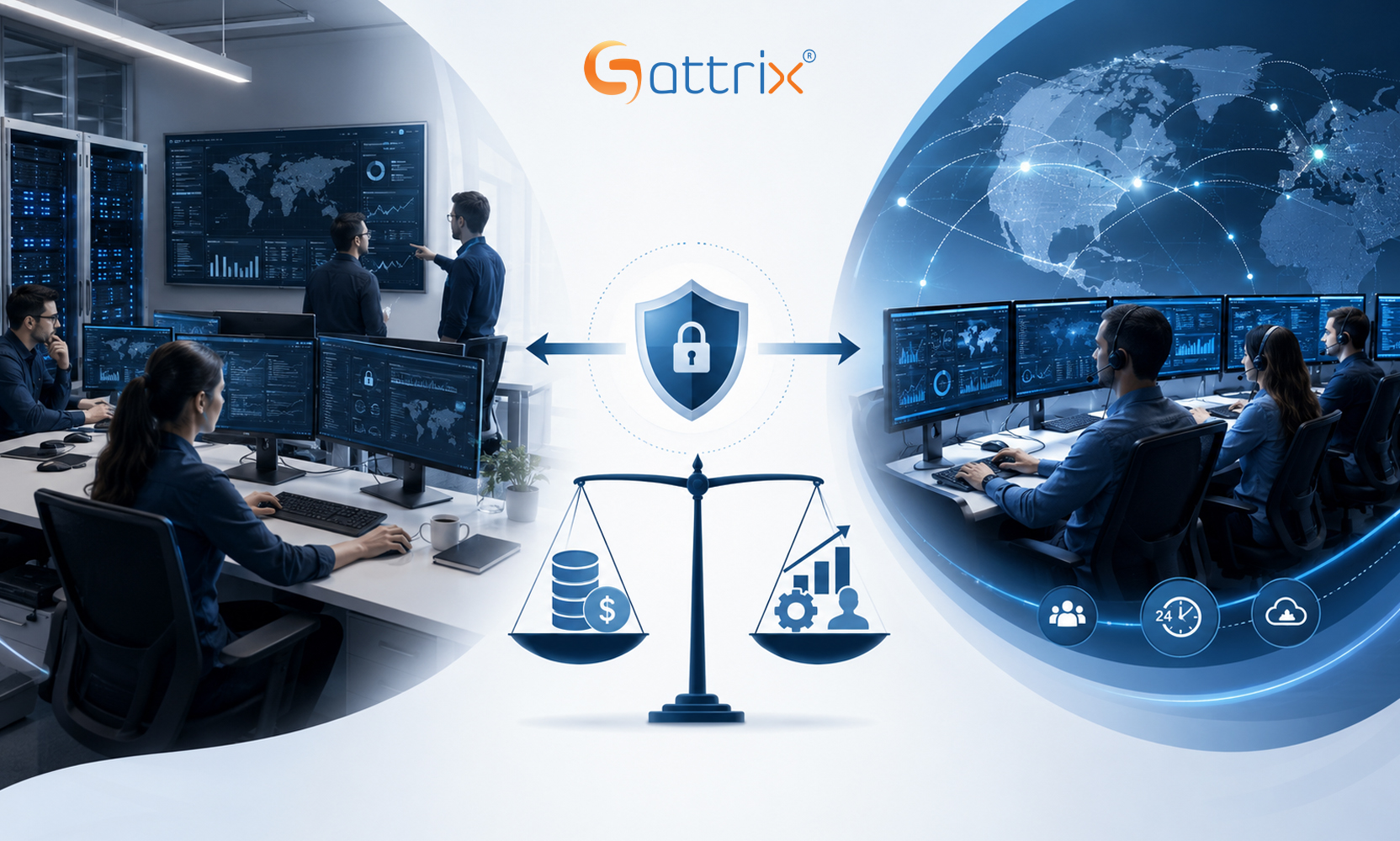
Cybersecurity threats continue to grow in frequency and complexity, making Security Operations Centers (SOCs) a critical part of every organization’s security strategy. A SOC provides continuous monitoring, threat detection, incident response, and security management to protect business assets from cyberattacks.
One of the biggest decisions organizations face is whether to build an internal SOC or partner with a managed security provider. Both approaches have advantages and challenges, and the right choice depends on business size, budget, compliance requirements, and available cybersecurity expertise.
This guide explains the SOC setup cost, compares build SOC vs outsource SOC, and helps organizations choose the best approach for their security goals.
A Security Operations Center is a dedicated team responsible for monitoring, detecting, investigating, and responding to cybersecurity threats around the clock.
A modern SOC typically includes:
The goal is to identify security incidents before they become major business disruptions.
Cyberattacks no longer target only large enterprises. Small and medium-sized organizations are equally vulnerable to:
Without continuous monitoring, attackers can remain undetected for weeks or even months.
A SOC significantly reduces detection time while improving incident response and business resilience.
One of the biggest factors influencing the decision is the SOC setup cost.
Building an internal SOC involves much more than purchasing security software.
Typical expenses include:
Organizations need:
These technologies often require substantial licensing and maintenance costs.
An internal SOC requires experienced professionals, including:
Recruiting and retaining skilled cybersecurity professionals is becoming increasingly difficult due to the global talent shortage.
Cybersecurity evolves rapidly.
Internal teams require ongoing:
Training is an ongoing investment.
A true SOC operates around the clock.
Providing continuous coverage requires multiple shifts, additional staffing, management oversight, and operational support.
This significantly increases long-term operational expenses.
Some organizations prefer complete ownership of their security operations.
Advantages include:
Internal teams have direct control over:
This allows security operations to align closely with business objectives.
Internal analysts understand:
This context often improves threat investigation accuracy.
Organizations can create:
Customization may be important for highly regulated industries.
Security teams can work closely with:
This improves communication during security incidents.
Although attractive, building a SOC comes with significant challenges.
The overall SOC setup cost can be substantial because organizations must purchase technology, infrastructure, and hire experienced personnel before operations even begin.
Finding experienced analysts remains one of the industry’s biggest challenges.
Organizations often struggle with:
Building a mature SOC may take several months or even more than a year.
Organizations must:
This delays operational readiness.
Technology updates, platform tuning, threat intelligence integration, and compliance reporting require continuous effort.
Without proper maintenance, SOC performance gradually declines.
Many organizations choose managed SOC services to improve security while controlling costs.
Instead of investing heavily upfront, organizations typically pay a predictable monthly or annual service fee.
This significantly reduces capital expenditure.
Managed SOC providers already have:
Organizations can begin receiving protection much faster.
Outsourcing provides access to:
Hiring these specialists internally would be expensive.
Managed providers deliver continuous monitoring without requiring organizations to build multiple shifts or maintain large internal teams.
Most providers include:
Organizations benefit from enterprise-grade tools without purchasing every platform individually.
While outsourcing offers many advantages, businesses should also consider potential limitations.
Daily monitoring activities are handled by the external provider.
Strong communication and clearly defined service agreements help address this concern.
Not all managed SOC providers offer the same level of expertise.
Businesses should evaluate:
Choosing the right partner is essential.
External SOC teams must integrate with existing:
Proper planning ensures smooth deployment.
| Factor | Build Internal SOC | Outsource SOC |
|---|---|---|
| Initial investment | Very high | Lower |
| Operational cost | High | Predictable subscription |
| Deployment speed | Slow | Fast |
| Security expertise | Internal hiring required | Available immediately |
| 24/7 monitoring | Requires multiple shifts | Included |
| Technology investment | Organization purchases tools | Usually included |
| Scalability | Slower | Easier |
| Maintenance | Internal responsibility | Provider managed |
| Compliance support | Internal effort | Often included |
| Best for | Very large enterprises | Organizations of all sizes |
When evaluating build SOC vs outsource SOC, many businesses find outsourcing delivers faster value, while large enterprises with unique operational needs may benefit from building an internal capability.
Building an internal SOC may be suitable for organizations that:
Outsourcing is often ideal for organizations that:
Many global businesses adopt a hybrid model, combining internal security leadership with outsourced monitoring and incident response.
Organizations looking to improve cybersecurity without the complexity of building an internal SOC can benefit from experienced managed security partners. Sattrix delivers managed SOC services designed to provide continuous threat monitoring, rapid incident response, advanced threat detection, and compliance support. By combining skilled security professionals with modern security technologies, businesses can strengthen their cyber resilience while keeping operational costs under control.
Choosing between building an internal SOC and outsourcing security operations depends on your organization’s goals, resources, and risk profile.
An in-house SOC offers greater control and customization but requires significant investment in technology, infrastructure, and skilled professionals. Outsourcing provides faster implementation, lower operational costs, continuous monitoring, and access to experienced cybersecurity experts.
Before making a decision, carefully evaluate your business requirements, regulatory obligations, available budget, and long-term security strategy. The right approach should not only reduce cyber risk but also support future growth and operational efficiency.
The SOC setup cost varies depending on organization size, technology requirements, staffing, and operational scope. Building a fully operational 24/7 SOC generally requires a significant investment in tools, infrastructure, and skilled personnel.
Yes. For many organizations, outsourcing reduces upfront investment and provides access to experienced security professionals, enterprise-grade technologies, and continuous monitoring through a predictable subscription model.
The primary difference is ownership and resource responsibility. Building a SOC requires internal hiring, technology investments, and ongoing management, while outsourcing transfers daily monitoring and operations to a managed security provider.
Yes. Many businesses use a hybrid model where internal teams focus on governance, strategy, and risk management while an external provider handles 24/7 monitoring, threat detection, and incident response.
Key considerations include budget, compliance requirements, available cybersecurity talent, desired level of control, scalability, operational maturity, and the need for around-the-clock security monitoring.


