

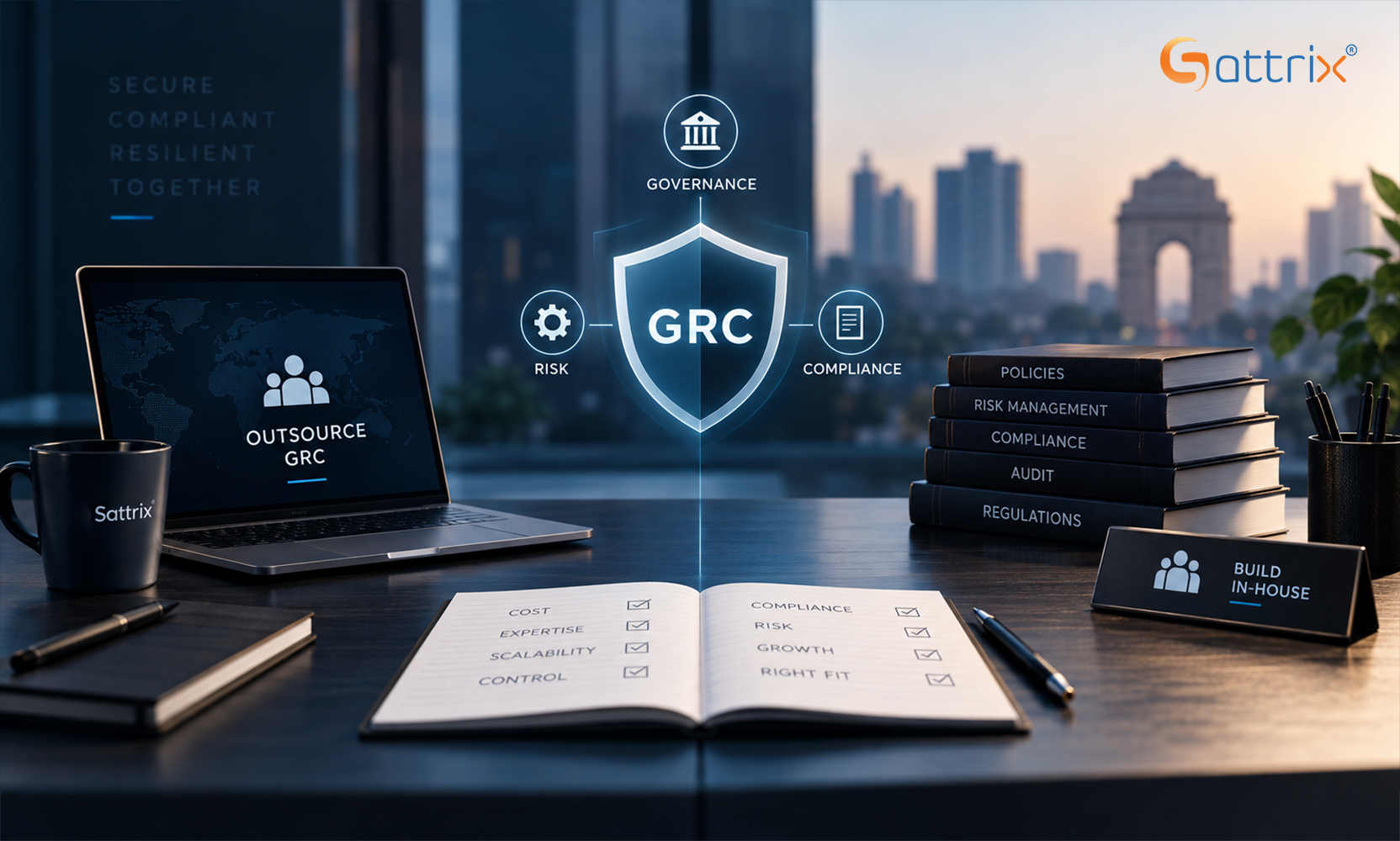
Most compliance programmes in Indian businesses start with a deadline. A customer asks for ISO 27001 certification, a regulator issues new directions, or an auditor schedules a review, and a team is pulled together to close the gaps. Once the audit passes, attention moves elsewhere until the next one arrives.
This pattern hides an important reality. Governance, Risk and Compliance (GRC) does not end when a certificate is issued. Controls drift, regulations change, new systems are added, and customers keep asking for evidence. That is why choosing between building GRC capabilities internally and adopting GRC as a Service in India should be treated as an operating-design question, not a procurement decision. The real issue is how your organisation will run GRC every month, not who will help you pass the next audit.
For most organisations, GRC covers three connected areas:
In practice, this means recurring work: maintaining policies, running risk assessments, mapping controls to frameworks, collecting evidence, tracking remediation, responding to customer security assessments, and reporting to management. For a growing business, this workload usually grows faster than headcount.
A project has a start, an end, and a handover. Compliance has none of these. ISO 27001 certification requires surveillance audits. The Digital Personal Data Protection (DPDP) Act, 2023 introduces ongoing obligations around consent, data handling, and breach response. CERT-In directions set incident reporting timelines, and sector regulators such as RBI, SEBI, and IRDAI continue to update their cybersecurity expectations.
When compliance is treated as a project, teams scramble before audits, evidence is collected retrospectively, and controls that look healthy on paper may not be working as designed. Treating it as an operating function shifts the focus to continuous compliance monitoring, where evidence is gathered as work happens and gaps surface early.
Building GRC in-house means hiring and retaining a team that owns policies, risk assessments, control management, audits, and reporting, supported by internal tools. A GRC-as-a-Service model means engaging an external provider to deliver some or all of that execution on an ongoing basis, usually with its own specialists, methodology, and tooling.
Neither model is inherently better. Here is how they typically compare:
| Factor | Building GRC In-House | GRC-as-a-Service Model |
|---|---|---|
| Internal expertise | Depends on who you can hire and retain | Access to specialists across frameworks |
| Regulatory complexity | Manageable when obligations are few and stable | Suits multiple or changing obligations |
| Scalability | Fixed capacity; peaks strain the team | Capacity can flex during audits |
| Audit readiness | Strong if processes are mature | Recurring readiness built into the service |
| Evidence management | Built and maintained internally | Often part of provider processes |
| Customer questionnaires | Handled alongside other work | Supported with maintained answer libraries |
| Reporting | Deep business context | Structured formats, needs your context |
| Technology | You select and maintain tools | Tools often included |
| Business involvement | High and constant | Still required for decisions and evidence |
| Cost structure | Salaries, tools, training, overheads | Service fees plus internal oversight |
| Operational continuity | Exposed to attrition | Less dependent on individuals, depends on provider quality |
| Flexibility | Full control over priorities | Scope set by contract, adjustable |
| Ownership and accountability | Retained by the business | Retained by the business |
Regulatory surface area is the full set of obligations your business must meet: laws such as the DPDP Act, sector regulations, standards such as ISO 27001, PCI DSS, or SOC 2, and security clauses in customer contracts.
A single-sector company operating only in India may have a manageable set. A business serving BFSI clients, processing payments, and selling into the US or Middle East may face several overlapping frameworks, each with its own evidence and reporting format. As this surface area grows, a fixed internal team struggles to keep pace, because the work expands in breadth, not just volume.
Count every assessment you face in a year: internal audits, certification and surveillance audits, regulatory reviews, customer audits, and recurring evidence requests. Many businesses are surprised by the total.
When preparation starts only as an audit approaches, staff are pulled from regular work, evidence is rushed, and control failures are discovered too late to fix properly. Continuous evidence collection and control monitoring reduce this pressure. Whichever model you choose, the key question is who does this work continuously.
Enterprise customers routinely send security, privacy, and risk questionnaires during vendor onboarding and renewals. These can run to hundreds of questions and often require supporting documents.
Responses must match your actual controls, stay consistent with earlier answers, and reflect recent changes. When questionnaires are handled ad hoc by whoever is available, inconsistencies creep in and deals slow down. Questionnaire management belongs in the ongoing GRC workload, not in the category of occasional sales tasks.
Boards and senior management increasingly expect clear reporting on cyber risk, compliance status, control effectiveness, open risks, and remediation progress. They want to understand business exposure, not control IDs.
GRC therefore has to translate technical and compliance data into business language, consistently, every reporting cycle. That requires people who understand both the controls and the business, and reporting processes that produce comparable information over time.
Consider whether you have documented policies, clear control owners, reliable asset inventories, suitable tools, and staff who know the relevant frameworks.
Organisations with mature processes and experienced staff may keep most GRC activities internal and use external help for specialist tasks. Organisations with limited capacity or early-stage processes may need external expertise, structured methodology, or managed support to build a stable foundation first.
A common approach is to compare the salary of one or two compliance hires with a service fee. This is one of the least useful ways to decide, because salary is only a small part of what it costs to run GRC.
The broader operating cost includes:
A service model carries internal costs too. Someone must manage the provider, supply context, and make decisions. The fair comparison is between two total operating models, not salary versus fees.
A well-structured external GRC service can provide capacity for recurring and peak workloads, expertise across frameworks, repeatable methodology and processes, documentation support, evidence management, control monitoring, compliance tracking, audit preparation, and reporting support for management and boards.
Cybersecurity providers such as Sattrix often offer GRC services alongside assessment and advisory work, which can help connect compliance activities with broader security operations.
Accountability cannot be outsourced, even when execution is outsourced. A provider can do the work, but the business must continue to own:
Regulators, auditors, and customers will hold the organisation responsible for outcomes, regardless of who prepared the evidence. Any service arrangement should define clearly which decisions stay internal and who signs off on them.
An in-house model may fit better when your regulatory surface area is limited and stable, internal processes and ownership are already mature, you can hire and retain experienced GRC professionals, compliance work depends heavily on proprietary business context, and leadership wants direct control over every activity.
A service model may be more suitable when you face multiple overlapping frameworks or operate across markets, audit volume is high or rising, customer questionnaires are frequent, internal maturity is still developing, specialist hiring has been difficult, or workload spikes sharply around audits and regulatory changes.
Yes, and many do. A hybrid model keeps strategic roles internal, such as a compliance head or risk manager who owns decisions and stakeholder relationships, while an external provider handles evidence collection, control testing, audit preparation, or questionnaire support.
This keeps business context and accountability inside the organisation while adding capacity and specialist depth. The key is clear boundaries: who owns which controls, who approves what, and how information flows between teams.
The choice between building GRC internally and using an external service should not be reduced to “hire a team or buy a service.” It is a question of how your organisation will operate governance, risk, and compliance continuously as regulations, customer expectations, audits, and business complexity evolve.
The right model depends on your regulatory surface area, operating complexity, audit demands, customer requirements, reporting expectations, and internal maturity, not simply on how many people you can hire. Whether execution sits internally, with a provider, or across both, accountability for risk and compliance outcomes stays with the business. Designing around that principle is what makes any GRC operating model sustainable.
It is an ongoing model in which an external provider delivers governance, risk and compliance activities such as risk assessments, evidence management, control monitoring, audit preparation, and reporting, while the business keeps decision-making authority.
Neither is universally better. The right choice depends on regulatory surface area, audit frequency, customer demands, reporting expectations, and internal maturity. Many organisations use a hybrid approach.
Evidence collection, control monitoring, policy drafting, risk assessments, audit preparation, questionnaire responses, compliance tracking, and reporting support are commonly outsourced.
No. Execution can be outsourced, but risk acceptance, policy approval, control ownership, and regulatory accountability stay with the business.
It can be, especially for businesses facing customer or regulatory demands without the scale to hire specialists across several frameworks. Internal ownership of decisions is still required.
Look at the provider’s framework expertise, methodology, tooling, reporting quality, and data handling practices, and how clearly the engagement separates execution from decision-making.


